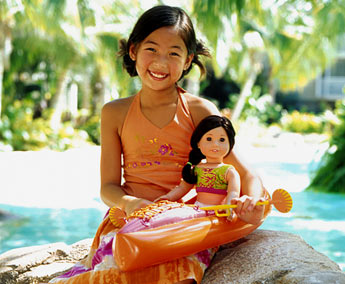
So we were down in LA at the grandparents' yesterday, and we went for my mom's customary morning coffee at the old Farmer's Market at 3rd and Fairfax before heading back to Bakersfield. My mom had been talking about how the new American Girl Place store had opened up last week in the humungous space previously occupied by F.A.O. Schwartz in the Grove, the outdoor mall/faux streetscape next to the Farmer's Market. Apparently, lines had been out the door for days and management moved employee parking to a building miles away (connected by shuttle) to open up the employee parking floor for the anticipated hordes of chaufferred doll aficionados coming for their "Afternoon Tea" with their dolls. Well, the store opens at 9:30 in the morning, before most other mall stores (guess it's never too early to buy matching pajamas so you can dress like your doll), so we strolled over to check it out after coffee.
I thought the F.A.O. Schwartz that was in the space before was creepy, what with the animatronics and the non-stop music. But this takes it to a whole other level. First of all, let me say that I'm not the most receptive audience for this. The whole girl-empowerment thing is great, but combining it with crass mass commercialism ["Buy matching clothes for you and your doll! And don't forget the accessories!"], not so much—and then add in my favorite problematizers, race and class, and, well.... Let's just say that The Pumpkin won't be taking her doppleganger doll to high tea there any time soon.
Everything is some shade of pink. All the saleswomen, smiling and quick with a greeting, seem creepily...doll-like. And everything, every object, every experience, is for sale. A giant display of dolls "Just Like You" advertises your little girl's ability to find a doll-ppleganger with the appropriate combination of hair color, hair texture (no naturals for you African American girls, though, only pressed or curls, sorry!), eye color, skin color, nose shape (couldn't tell if there were different eye shapes, but noses seemed limited to "regular" and "a little flatter")... Teeth, however, seem to be universally buck-. And don't forget the accessories, and the real-girl-sized clothes to match! And right next to that display is the...wait for it...hair salon. Yes, hair salon, where a row of miniaturized salon chairs sits on a counter, behind which stand the "stylists" waiting for their inanimate clients. Upstairs, you've got a cafe where you can eat three meals a day, book a birthday party, you can watch something (don't know if it's video or live, wasn't paying attention) in the theater, get your photo taken with your doll, buy a baby doll (and accessories! two-pack twins and a matching two-seater stroller!), buy doll-specific books, and check out/buy from the company's vaunted Historical Collection.
This 10-doll collection of characters from American historical periods from the eighteenth to the twentieth centuries, complete with novels, has been lauded for its sort of "girl power" version of fictionalized social history. In the last few years, they've added an African American (runaway slave), a Latina (New Mexican), and Native American (eighteenth century Plains)to the collection. Just out of curiosity, I checked the on-line store to see what matching clothes you could get to dress like your historical dolls—"Dress like a run-away slave!"—but, alas, it's mostly nightgowns. Except there's nothing for Nez Perce warrior girl Kaya—and I was so looking forward to buying The Pumpkin some faux buckskin jammies.
Angry Asian Man wrote last month about this Sacramento Bee article about Asian American girls and their parents who have started a campaign to get American Girl to add an Asian American character and story to the historical line. While I always applaud young activists and work on the issue of pop-cultural representation and diversity, I gotta say, I don't know what I'd think about, say, a 1940s-era Emi doll complete with a family i.d. number tag around her neck and a matching suitcase in which to put only what she could carry. Heh. Already I'm sorta uncomfortable with the "diversity" of the historical collection—I know they have to start somewhere, but in a collection of 10 dolls, in which the white dolls range from servant to elite and from colonial times to WWII, the non-white dolls are one black doll who's a runaway slave, one Native American doll who wants to be a warrior woman, and one Latina doll who's on a New Mexican ranch. It just seems a little too pat, a little too easy. And of course, I'm viewing this with the back-drop of last year's uproar over one of their contemporary dolls, Marisol, who, after the historical Josefina, was the company's second Latina doll. The Mexican-American character's backstory included her family's moving from Chicago's historically Latino Pilsen neighborhood to the suburbs because the old barrio was too dangerous and had no place for her to play. That, obvioulsy, didn't sit too well with proud residents of the ethnic enclave.
This year's "Girl of the Year" doll/character happens to be Jess, a biracial white/Asian 10-year-old, whose accompanying story/novel focuses on her family's vacaction in Central America. I have no idea if her racial/ethnic background comes into play in her story at all. But, surrounded by a whole lot of Jess dolls and Jess books at the store, I have to say... Sorry, American Girl, she may have a bridgeless nose, but she looks like a white girl with buckteeth. (As I mentioned earlier, apparently all the dolls have the same teeth.) It's interesting to note that the hapa girl in the article linked above, who wants an AsAm historical doll (and even plans to study history in college because of American Girl), said of Jess, "She looks almost Native American or Hispanic." When told she was AsAm, she said, "That's crazy." Um, sweetie, I know we all look different, but have you really not been asked if you speak Spanish yet? Or, with that interest in history, haven't you read about the settlement of the Americas by people from, um, Asia? But either way, that doll doesn't look hapa to me, though the illustrations for the book do.
At any rate, I'm not buying The Pumpkin an American Girl doll any time soon, regardless of how racially ambiguous I could make it look. [At a year-and-a-half, my babygirl's years too young anyway—and barely taller than the dolls. She was uninterested in the baby dolls aimed at toddlers and younger girls, only wanting to push the doll-sized stroller out of the showroom, sans doll.] And that store gives me the creeps. Too many clothing items that eight-year-olds (their target audience) should not be wearing—the Jess collection has her signature halter top, and I swear I saw something on the rack that looked like a tube top and hot pants or something. Nuh-uh. (Don't we have enought problems with the Pussycat Dolls joining the Bratz on the toystore shelves?) And the resemblance of the employees to their smiling, cheerful products, at 9:30 on a Monday morning, yeah, no thanks. No tea-with-your-doll for me.
Not that they're losing business from me. Apparently, the afternoon tea service is booked for months.